

Description
Factory & Site Acceptance Testing (FAT/SAT)



Overview
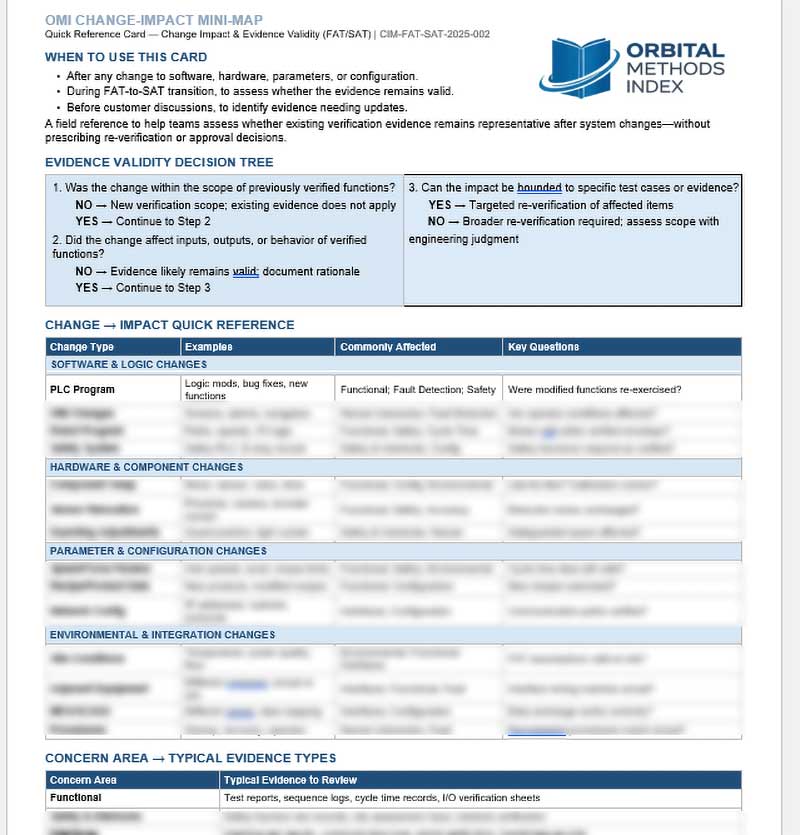
The OMI Change-Impact Mini-Map — FAT/SAT (CIM) is a two-page verification field tool designed to support acceptance-stage engineering discussions when systems change between Factory Acceptance Testing (FAT) and Site Acceptance Testing (SAT).
Late-stage software updates, hardware substitutions, parameter tuning, and integration changes often raise questions about whether previously generated verification evidence remains applicable. This OMI reference sheet helps teams assess change impact and evidence validity in a structured, defensible way—before those questions become acceptance disputes.
This expanded edition builds on the original OMI Change-Impact Mini-Map—included as part of the OMI Verification Readiness Framework (VRF)—by adding practical decision framing, evidence-impact reasoning, and reviewer-aligned questions, while remaining strictly non-prescriptive
What This Tool Does
The Change-Impact Mini-Map helps teams:
- Identify which verification concern areas are commonly affected by different types of system changes.
- Assess whether existing FAT evidence likely remains representative after a change.
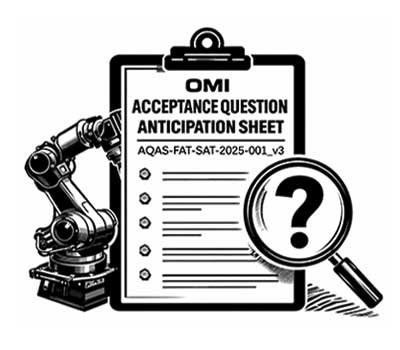
- Anticipate reviewer questions before customer acceptance discussions.
- Support clear internal alignment on when re-verification may be appropriate—without mandating it.
- Document rationale for evidence reuse, supplementation, or re-execution.
The Mini-Map helps teams separate change impact reasoning from change approval, keeping acceptance discussions scoped to evidence. The focus is evidence representativeness, not change approval.
What This Tool Is Not
This field reference does not:
- Mandate re-verification or testing.
- Define acceptance criteria.
- Approve or authorize changes.
- Serve as a change control process.
- Guarantee customer acceptance.
- Replace project-specific requirements or contracts.
It exists to support engineering judgment, not replace it.
What’s Inside (Expanded Edition)
This expanded field edition includes:
- 16 change types mapped to verification impact across software, hardware, configuration, integration, environmental, and procedural changes.
- 6 verification concern areas with typical evidence types affected by change.
- Evidence validity reasoning prompts to assess whether prior FAT evidence remains representative.
- 3×3 change severity × timing matrix distinguishing early, mid-stage, and late acceptance changes.
- 5 customer notification triggers that commonly prompt re-discussion or clarification.
- Reviewer-aligned key questions typically raised when changes occur.
How Teams Use It
- During internal change reviews before SAT.
- As a desk-side or meeting-room reference during acceptance discussions.
- When evaluating whether FAT evidence can be credibly reused.
- To support clear, defensible explanations to customers.
- As an onboarding aid for engineers new to acceptance-stage reviews.
Because it is designed for real-time use, the format is concise and structured for rapid reference.
OMI Change-Impact Mini-Map — At a Glance
- 16 change types mapped to FAT/SAT verification concern areas.
- 6 concern areas with typical evidence validity–focused types.
- 3-step evidence validity decision tree.
- 3×3 change severity and timing matrix.
- 4 re-verification response levels.
- 5 customer notification triggers.
- Supports judgment without prescribing outcomes.
- 2 Page field-ready laminated reference sheets or printable PDF format.
Licensing & Delivery
- Digital PDF download.
- Professionally formatted, non-editable file.
- Licensed proprietary intellectual property.
- Covered under the OMI Usage & Licensing Terms.
- Perpetual internal-use license for one organization or individual professional.