
Description
VCM-MW-P01: Core Verification Coverage Map™ — Momentum Wheels
$1,997.00 | Digital Download (PDF)

What Is Inside This Reference
The Core Verification Coverage Map is a 40+-page professional reference documenting 60+ verification concerns across eight functional domains for reaction wheel and momentum wheel assemblies.
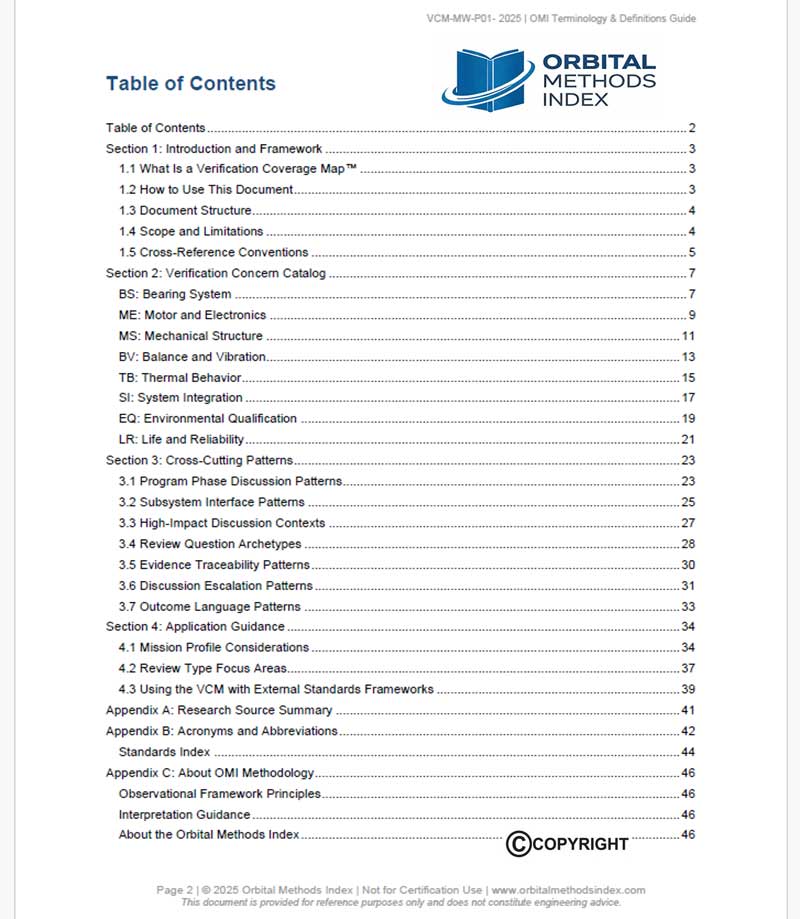
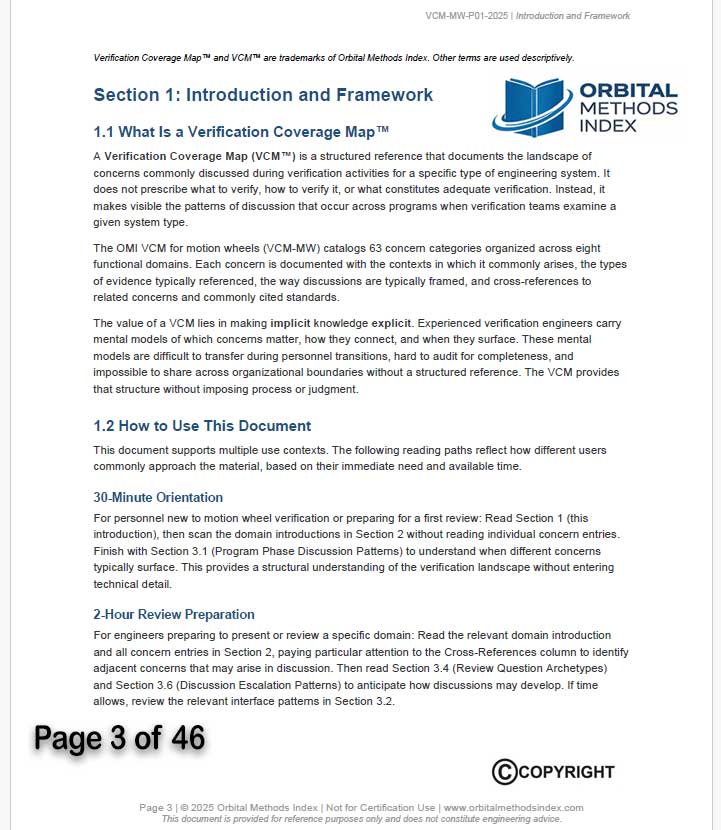
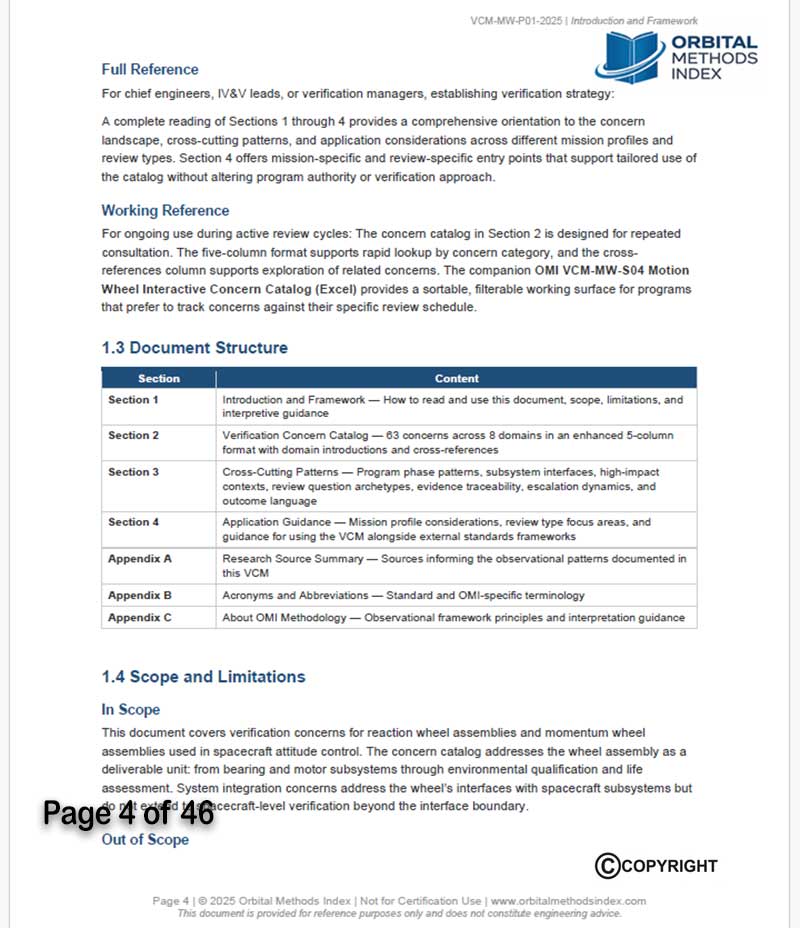
Section 1: Introduction and Framework
- Four structured reading paths (30-minute orientation to full reference)
- Scope boundaries and interpretive guidance
- Cross-reference conventions for navigating the catalog
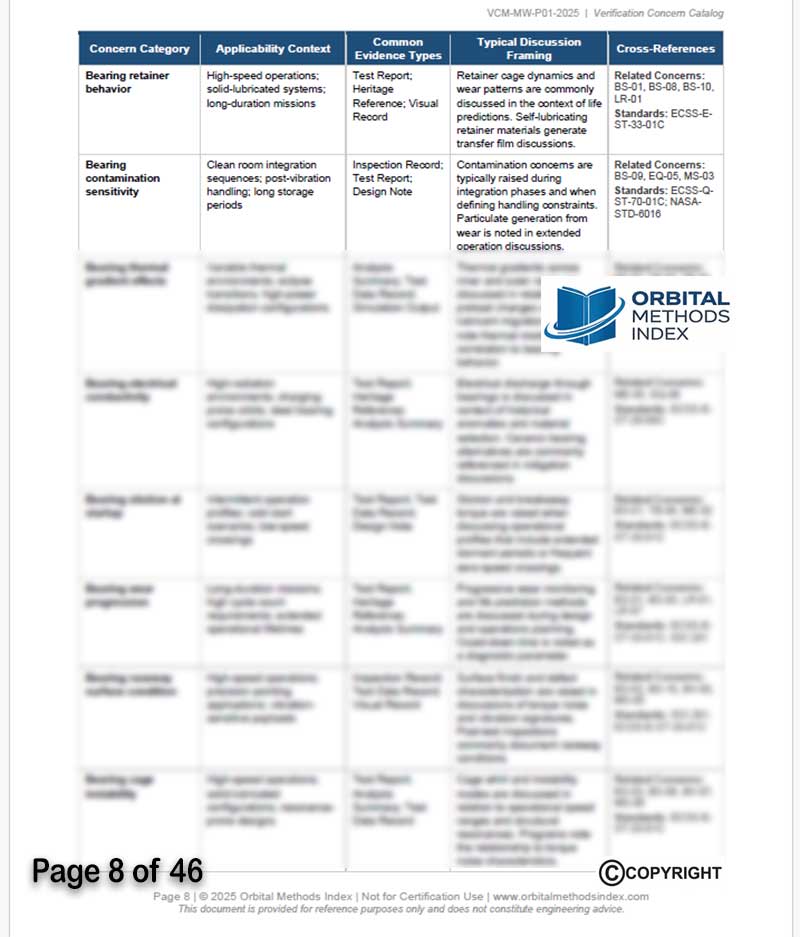
Section 2: Verification Concern Catalog
- 63 concerns organized by functional domain
- Enhanced 5-column format: Concern Category, Applicability Context, Common Evidence Types, Typical Discussion Framing, and Cross-References
- Domain introductions providing review dynamics context
Functional Domains Covered
- Bearing System (10 concerns)
- Motor and Electronics (10 concerns)
- Mechanical Structure (8 concerns)
- Balance and Vibration (8 concerns)
- Thermal Behavior (6 concerns)
- System Integration (7 concerns)
- Environmental Qualification (7 concerns)
- Life and Reliability (7 concerns)
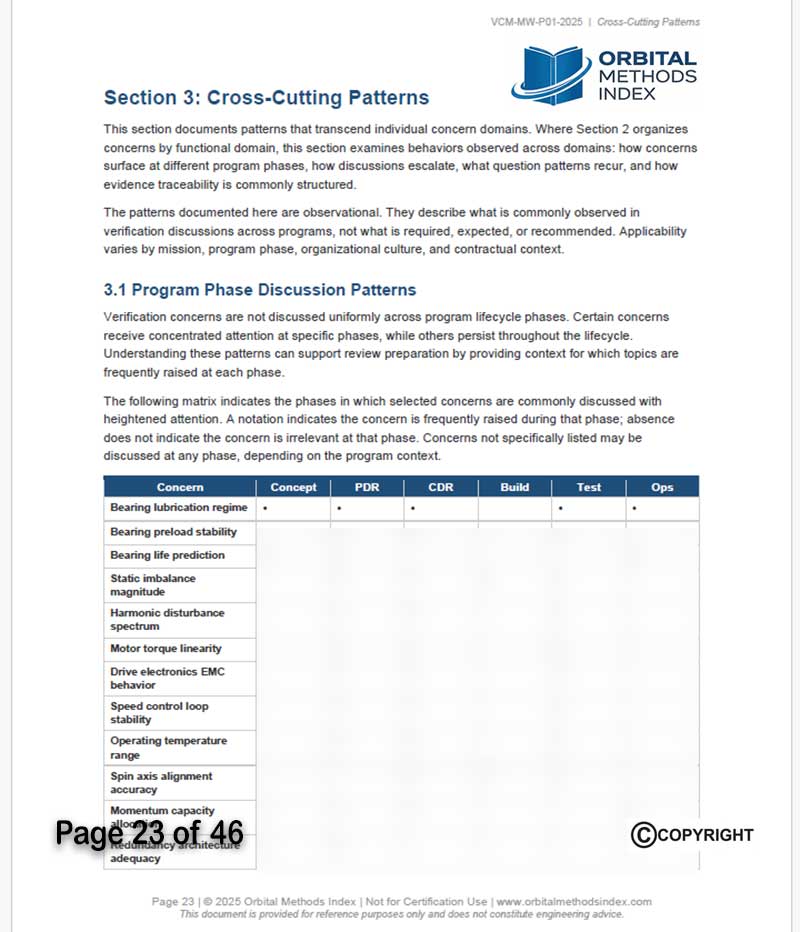
Section 3: Cross-Cutting Patterns
- Program phase discussion patterns
- Subsystem interface patterns (ADCS, EPS, Thermal, Structures)
- High-impact discussion contexts
- Review question archetypes
- Evidence traceability patterns
- Discussion escalation triggers
- Outcome language patterns
Section 4: Application Guidance
- Mission profile considerations (LEO Precision Pointing, GEO Continuous Operation, Deep Space Long-Duration, High-Agility Imaging)
- Review type focus areas (PDR, CDR, TRR, QR, AR, MRR)
- Standards framework integration guidance (ECSS, NASA, MIL)
Appendices
- Research source summary
- 42 acronyms and abbreviations
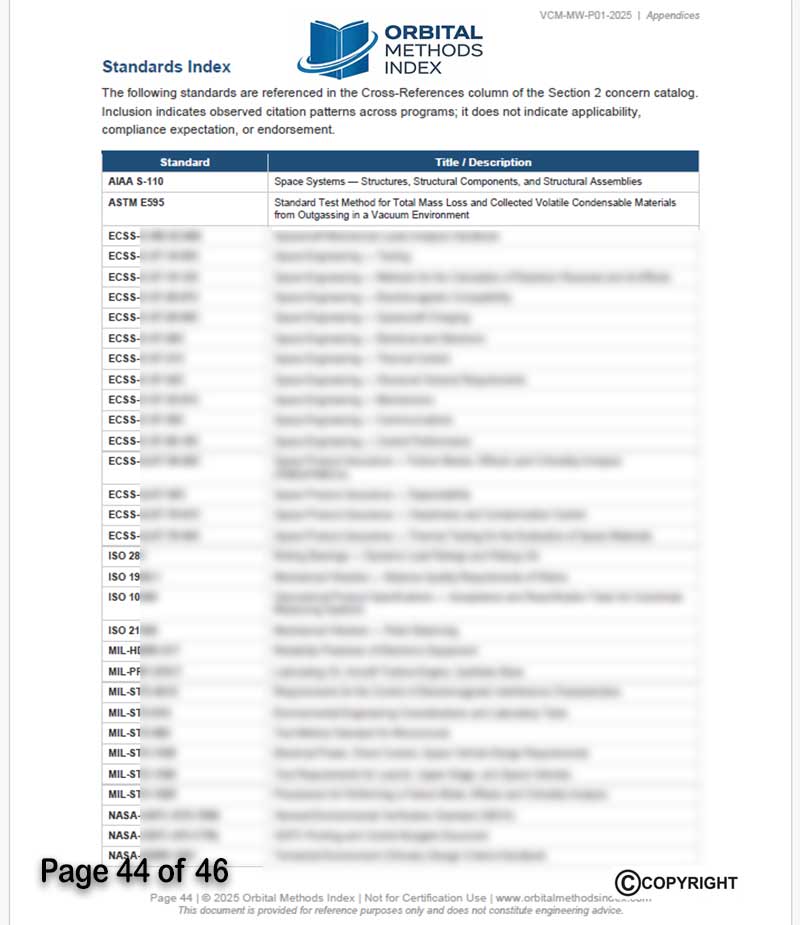
- 42 standards with full titles
- OMI methodology explanation
How This Reference Is Intended to Be Used
The VCM-MW-P01 serves as a verification discussion reference—not a checklist, not a specification, not a set of requirements.
- Before Reviews: Identify which concerns are likely to surface based on your mission profile, program phase, and review type. Use the cross-references to anticipate adjacent discussions.
- During Reviews: Reference typical discussion framing to understand how concerns are commonly articulated. Use the evidence traceability patterns to follow how questions connect across artifacts.
- For Verification Planning: The concern catalog provides a structured inventory for assessing coverage without prescribing what must be verified. Your program determines relevance; the VCM makes the landscape visible.
- For Team Alignment: The standardized concern taxonomy provides common vocabulary across verification teams, suppliers, and reviewers—reducing ambiguity in what is being discussed.
Reading Paths by Time Available
- 30 minutes: Section 1 + domain introductions + Section 3.1 (Program Phase Patterns)
- 2 hours: Full domain review + Sections 3.4 and 3.6 (Question Archetypes and Escalation Patterns)
- Full reference: Complete reading of all sections for verification strategy development
Who This Is For
Primary Users
- Verification Engineers preparing for or conducting momentum wheel verification activities
- QA/QC Leads establishing verification coverage frameworks
- Chief Engineers and Technical Authorities overseeing wheel procurement and integration
- IV&V Teams assessing verification completeness independently
Organizational Contexts
- Spacecraft prime contractors integrating procured wheel assemblies
- Subsystem integrators coordinating wheel verification with spacecraft-level activities
- Independent review teams assessing verification adequacy
- Engineering organizations establishing internal verification practices
Experience Levels
- Engineers new to momentum wheel verification seeking structured orientation
- Experienced practitioners seeking comprehensive reference and cross-domain visibility
- Technical managers seeking frameworks for team alignment and coverage assessment
Not Intended For
- Supply chain qualification or vendor quality system assessment
- Ground support equipment verification
- Flight software verification (wheel firmware interfaces are addressed at the boundary only)
Relationship to Other OMI Tools
The VCM-MW-P01 is the core reference in the momentum Wheel verification framework. Other OMI tools provide targeted access points and working surfaces.
| Product | Relationship to VCM-MW-P01 |
|---|---|
| VCM-MW-S01: Language & Framing Guide ($247) | Expands on the observational language conventions used throughout P01. Use when you need deeper guidance on non-prescriptive framing. |
| VCM-MW-S02: Review Preparation Guide ($297) | Tactical preparation tool derived from P01’s review type focus areas and escalation patterns. Use when preparing for a specific upcoming review. |
| VCM-MW-S03: Terminology & Definitions Guide ($199) | Reference companion to P01’s technical vocabulary. Use when clarifying terminology in specifications or discussions. |
| VCM-MW-S04: Interactive Concern Catalog ($347) | Excel working surface containing P01’s 63-concern catalog in sortable, filterable format with program-specific tracking columns. Use for active verification tracking. |
| VCM-MW-F01: Evidence Taxonomy Quick Reference (FREE) | Single-page extract of evidence type definitions used in P01’s catalog. |
| VCM-MW-F02: Terminology Cheat Sheet (FREE) | Quick-reference extract of key terms from P01. |
| VCM-MW-F03: Top 15 Scrutinized Concerns (FREE) | Subset of P01’s high-impact discussion contexts for rapid orientation. |
Licensing & Delivery
- Digital PDF download
- Immediate access after checkout
- Professionally formatted, non-editable file
- Licensed proprietary intellectual property
- Covered under the OMI Usage & Licensing Terms
- Perpetual internal-use license for one organization or individual professional, unless otherwise specified
Executive / Procurement Justification
The Problem This Solves
Momentum wheel verification discussions draw on implicit knowledge that experienced engineers carry but rarely document. When key personnel transition, when programs encounter unfamiliar wheel configurations, or when verification teams span organizational boundaries, this implicit knowledge becomes a liability.
Programs experience:
- Verification gaps discovered late in review cycles
- Repeated discussions about “what we should have asked”
- Inconsistent coverage depth across review types
- Difficulty demonstrating verification completeness to customers or oversight
What This Reference Provides
The VCM-MW-P01 makes implicit verification knowledge explicit without imposing process or prescribing approach. It provides:
- Structured inventory of 60+ verification concerns across eight functional domains
- Discussion context showing when and how concerns typically surface
- Cross-domain visibility revealing how concerns connect and escalate
- Evidence patterns documenting how verification threads are commonly traced
- Mission-specific guidance for tailoring coverage to program characteristics
Return on Investment
At $1,997, the VCM-MW-P01 costs less than eight hours of senior engineer time at typical aerospace labor rates.
The reference supports:
- Reduced rework from late-discovered verification gaps
- Faster onboarding for personnel new to momentum wheel verification
- More efficient review preparation through structured concern identification
- Improved audit readiness through documented coverage rationale
- Better supplier/customer alignment through common verification vocabulary
Procurement Considerations
- Format: PDF (primary)
- License: Single-organization use with unlimited internal distribution
- Updates: Registered purchasers receive notification of future revisions
- No subscription required: One-time purchase, permanent access
Risk Reduction
Momentum wheels are often mission-critical, life-limited components where verification inadequacy can result in pointing performance shortfalls, premature degradation, or operational anomalies. The VCM-MW-P01 supports verification completeness without adding process overhead—making verification discussions more thorough, not more burdensome.
The Verification Coverage Map is a non-prescriptive reference framework. It does not establish requirements, define verification sufficiency, or substitute for program-specific engineering judgment. Organizations remain solely responsible for their verification decisions.