
Description
Factory & Site Acceptance Testing (FAT/SAT)

Overview
A structured, real-time witness and acceptance record that documents what verification was performed, against what baseline, under what authority, and with what outcome — at the moment the event occurs. Trusted by engineering teams who can’t afford documentation ambiguity.
Why This Tool Exists
During FAT or SAT, verification proceeds correctly—but the record of what was witnessed and accepted often gets reconstructed later from memory or notes.
This gap costs money:
- Engineers remember the test intent.
- Customers recall a different scope.
- QA sees acceptance language that overstates what occurred.
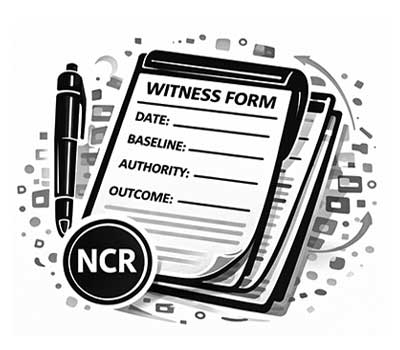
The OMI Universal Verification Witness Form captures the moment verification becomes accepted truth—clearly and defensibly— while all parties are present.
What This Tool Actually Does
Prevents post-event acceptance disputes by creating an identical, contemporaneous record for all parties.
How it works:
- Declares verification context and scope up front
- Records result separately from acceptance decision
- Documents who had acceptance authority
- Produces instant duplicate copies (White: Contractor, Yellow: Customer)
Result: No reconstruction. No reinterpretation. No ambiguity.
How This Differs from the OMI Evidence Boundary Reference (EBR)
These tools are intentionally complementary:
OMI Evidence Boundary Reference (EBR) helps teams frame what evidence does and does not demonstrate- OMI Universal Verification Witness Form (UVWF) records what verification event actually occurred and what was accepted
In practice:
- Teams use the EBR to answer scope questions during discussion.
- Teams use the UVWF to document the outcome of the verification event itself.
One clarifies meaning.
The other captures decision.
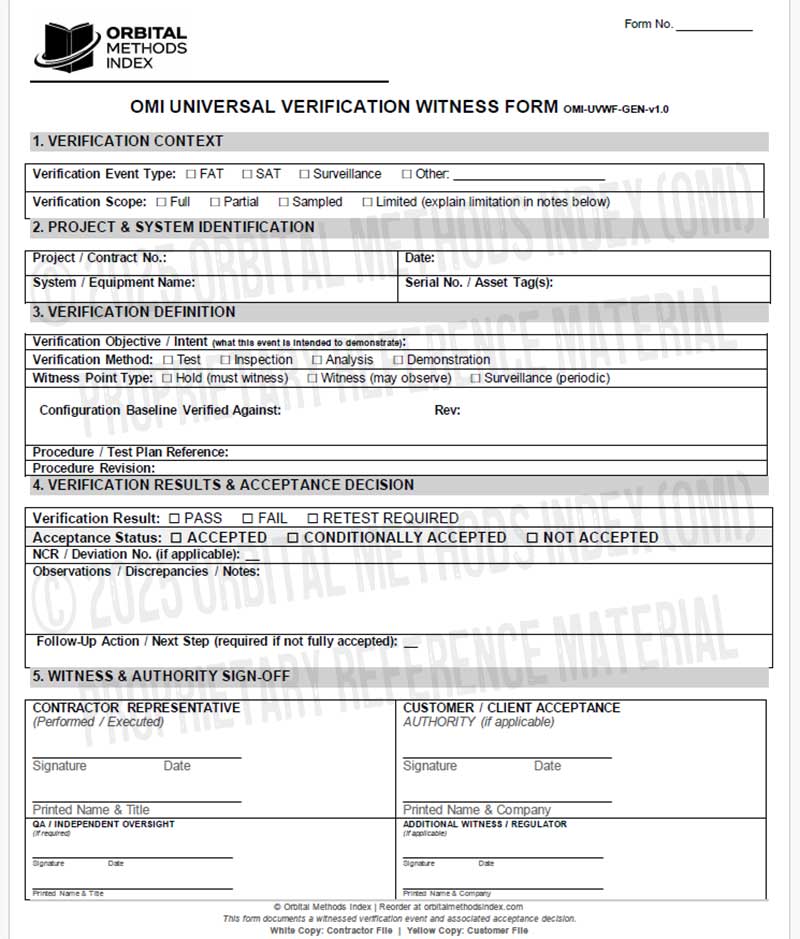
What’s Inside (Universal Verification Witness Form)
Each NCR form includes structured sections for:
Verification Context
- Verification event type (FAT, SAT, surveillance, other)
- Declared verification scope (full, partial, sampled, limited)
Project & System Identification
- Project / contract reference
- System or equipment identification
- Serial number or asset tag(s)
Verification Definition
- Verification objective / intent
- Verification method (test, inspection, analysis, demonstration)
- Witness point type (hold, witness, surveillance)
- Procedure or test plan reference
- Configuration baseline verified against
Verification Results & Acceptance Decision
- Verification result (pass / fail / retest required)
- Acceptance status (accepted / conditionally accepted / not accepted)
- NCR or deviation reference (if applicable)
- Observations and follow-up actions
Witness & Authority Sign-Off
- Contractor representative (performed/executed)
- Customer / client acceptance authority
- QA or independent oversight (if applicable)
- Additional witness or regulator (if applicable)
How Teams Use It
- During FAT/SAT to document witnessed events in real-time.
- When multiple stakeholders need immediate proof of acceptance.
- To prevent “wait, what did we actually accept?” disputes.
- As supporting evidence alongside test reports.
- When acceptance authority must be explicit and defensible.
Because it’s completed during the event—not after—it eliminates post-event disputes and documentation gaps.
OMI UVWF — At a Glance
- Single-page, two-part NCR (carbonless) form.
- White copy: Contractor file.
- Yellow copy: Customer file.
- 8.5 × 11 in, handwriting-friendly layout.
- Explicit separation of verification result and acceptance status.
- Authority-based sign-off structure.
- Designed for FAT, SAT, and formal witnessed verification events.
What You Get
Each pad contains:
- 50 two-part NCR forms (White + Yellow copies)
- Sequential numbering for traceability
- Chipboard backing for field use
- Professional OMI branding
- Heavy-duty carbonless paper
Form specifications:
- Size: 8.5″ × 11″
- Format: Single-page, hand-writable
- Ink: Black (high contrast for copies)
- Binding: Top-padded, tear-off
Formats & Options
Physical NCR Pads (shipped)
- Pads contain 50 two-part forms each.
- Minimum order: 2 pads.
Available packs:
- Field Pack (2 pads)
- Team Pack (6 pads)
- Program Pack (10 pads)
All options contain identical content.
Frequently Asked Questions
Q: Can I get these with my company logo?
A: Custom branding available for orders of 50+ pads. Contact support@orbitalmethodsindex.com.
Q: What’s the difference between this and a checklist?
A: This isn’t a test procedure—it’s an acceptance record. It documents what was verified and who accepted it, not how to perform the test.
Q: Do both parties sign the same form?
A: Yes. All signatures are on both copies before separation. This prevents “I never signed that” disputes.
Q: How long does shipping take?
A: Pads are printed on-demand—ships within 10-15 business days via USPS Priority Mail (2-3 days in transit). Need it faster? Contact us about expedited options.
Q: What if I need industry-specific fields?
A: Contact us about aerospace, defense, or industrial automation editions.
What This Tool Is — and Is Not
This form is:
- A witnessed verification event record.
- An acceptance and authority documentation aid.
- A companion to test procedures and reports.
This form is not:
- A test procedure or checklist.
- A requirements traceability document.
- A compliance or certification artifact.
- A substitute for verification evidence.
Licensing & Delivery
- Physical shipment of NCR pads.
- Licensed proprietary OMI intellectual property.
- Covered under the
OMI Usage & Licensing Terms
.
Executive / Procurement Justification
A low-friction, acceptance-stage field tool that reduces documentation ambiguity and post-event disputes by capturing
who verified what, under what conditions, and with what authority
—at the moment acceptance occurs.