Description
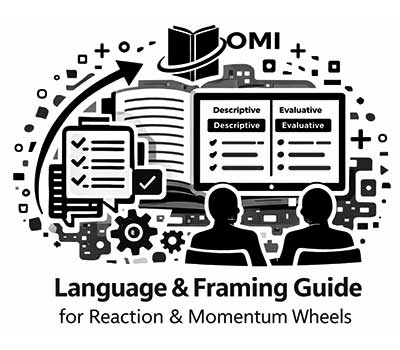
OMI Language & Framing Guide — Reaction & Momentum Wheels

Verification reviews rarely derail because data is missing. They derail because language carries unintended implications.
Words such as qualified, validated, heritage, representative, and acceptable often signal more than the speaker intends—especially when used across disciplines, organizations, or program phases.
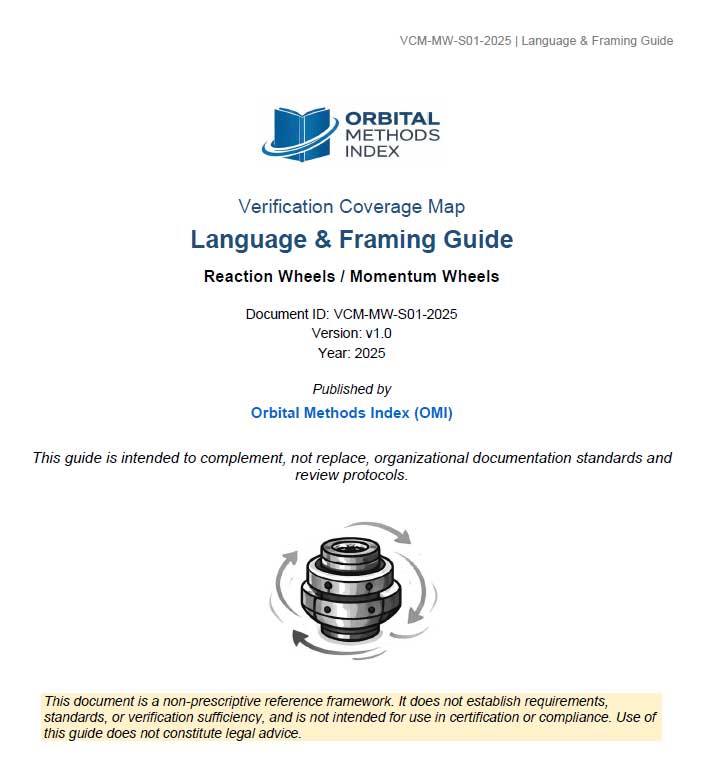
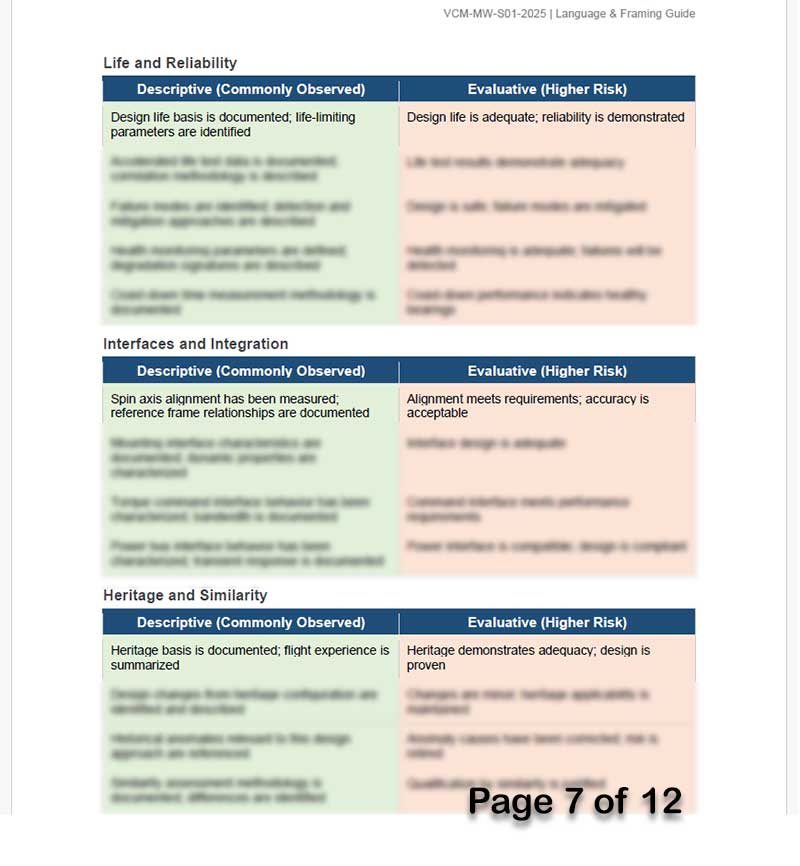
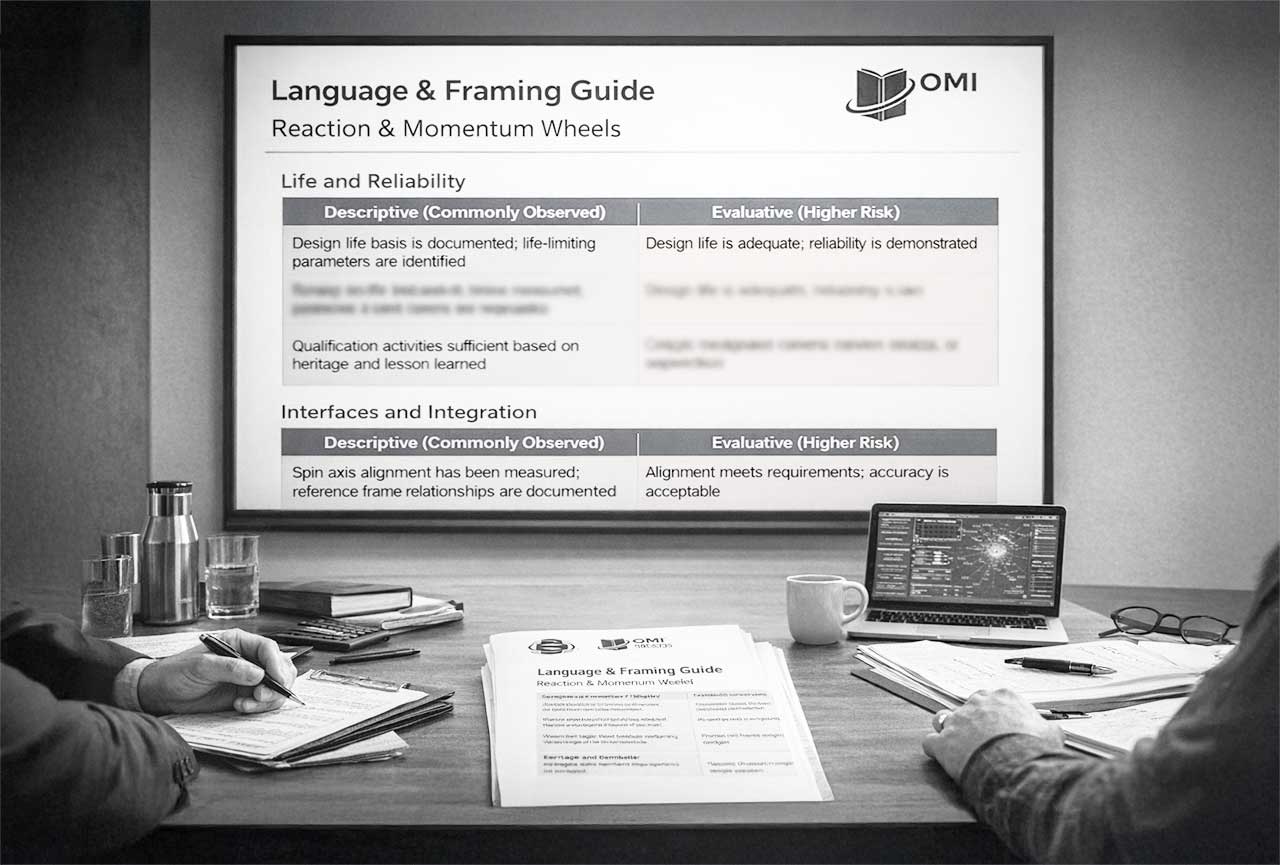
The OMI Language & Framing Guide — Reaction & Momentum Wheels (VCM-MW-S01) provides a structured, non-prescriptive orientation to how commonly used verification language related to motion wheel systems is typically interpreted during spacecraft reviews.
This guide reflects observed review behavior, not authoritative definitions, requirements, or standards.
What This Reference Covers
This 12-page guide examines how verification language is commonly framed and interpreted in discussions involving reaction and momentum wheel systems, including:
- The risk: Why language choices matter in verification contexts, including legal and programmatic implications
- Descriptive vs. evaluative language: 30 side-by-side comparisons organized by technical domain
- Edge cases: How to respond when directly asked about compliance, how to describe anomalies, and how to frame heritage claims with appropriate caveats
- Quick reference: Safe phrase patterns and phrases to avoid for rapid consultation
Examples are drawn from observed review contexts and presented as interpretation patterns, not guidance.
How This Reference Is Intended to Be Used
- As a pre-review reference before writing verification reports or presentations
- As a shared awareness tool during PDR, CDR, TRR, and qualification reviews
- As an orientation resource for engineers entering motion wheel verification discussions
- As a neutral framing aid when language begins to drive scope expansion
- As a supporting reference for cross-discipline communication alignment
This document does not prescribe terminology usage, establish requirements, or define verification sufficiency.
Who This Is For
- Systems engineers supporting spacecraft attitude control reviews
- GNC engineers discussing reaction and momentum wheel performance
- Mechanical engineers contributing verification evidence
- Mission assurance and quality leads participating in review discussions
- Program teams navigating multi-organization verification communication
- Engineers preparing verification reports, presentations, or technical assessments
Relationship to Other OMI Tools
This guide pairs naturally with:
- OMI Evidence Taxonomy Quick Reference (VCM-MW-F01) — how evidence types are commonly categorized and referenced in reviews
- OMI Motion Wheels Terminology Cheat Sheet (VCM-MW-F02) — how motion-wheel terms are typically understood during verification discussions
- OMI 15 Most Scrutinized Concerns — Motion Wheels (VCM-MW-F03) — which topics most consistently attract deep scrutiny and scope expansion
Together, these references address language, terminology, evidence framing, and review focus—without prescribing requirements or asserting outcomes.
Licensing & Delivery
- Digital PDF download
- Immediate access after checkout
- Professionally formatted, non-editable file
- Licensed proprietary intellectual property
- Covered under the OMI Usage & Licensing Terms
- Perpetual internal-use license for one organization or individual professional, unless otherwise specified
Executive / Procurement Justification
A structured, motion-wheel–specific language and framing reference that reduces review friction by making common interpretation patterns visible—helping teams avoid unintended closure, sufficiency, or acceptance implications during PDR, CDR, TRR, and qualification discussions. This guide supports clearer cross-discipline communication without scripting responses, expanding scope, or altering approval authority.
Why OMI Publishes This
OMI frameworks focus on how verification is experienced and interpreted during real engineering reviews—not how it is theoretically structured.
By making common language-interpretation patterns explicit, teams can reduce unintended commitments, limit unnecessary scope expansion, and keep reviews focused on technical substance rather than semantic interpretation.
This reference is part of the OMI Verification Coverage Map for Motion Wheels (VCM-MW) product line, which includes evidence taxonomy references, terminology guides, review-focus maps, and deeper verification frameworks.