



Description
VCM-MW-P02: OMI Reaction & Momentum Wheel Verification Coverage Map™ ~ Complete Implementation Package
$2,997.00 | Digital Download includes (PDF,.XLSX,.PPTX).
Delivery: Immediate access upon purchase.
This is the complete OMI Reaction/Momentum Wheel (9 File) Product Package. (Individual component value: $3,087).

What This Package Provides
The Complete Implementation Package delivers the entire OMI verification framework for reaction wheels and momentum wheels in spacecraft applications. This nine-component suite provides everything needed to navigate verification discussions from early design reviews through final acceptance testing.
The package includes the comprehensive 63-concern catalog, interactive working tools, planning worksheets, presentation materials, research documentation, and implementation guidance. Each component is designed to work independently or as part of an integrated verification approach.
Complete Package Contents
Core Reference Documentation
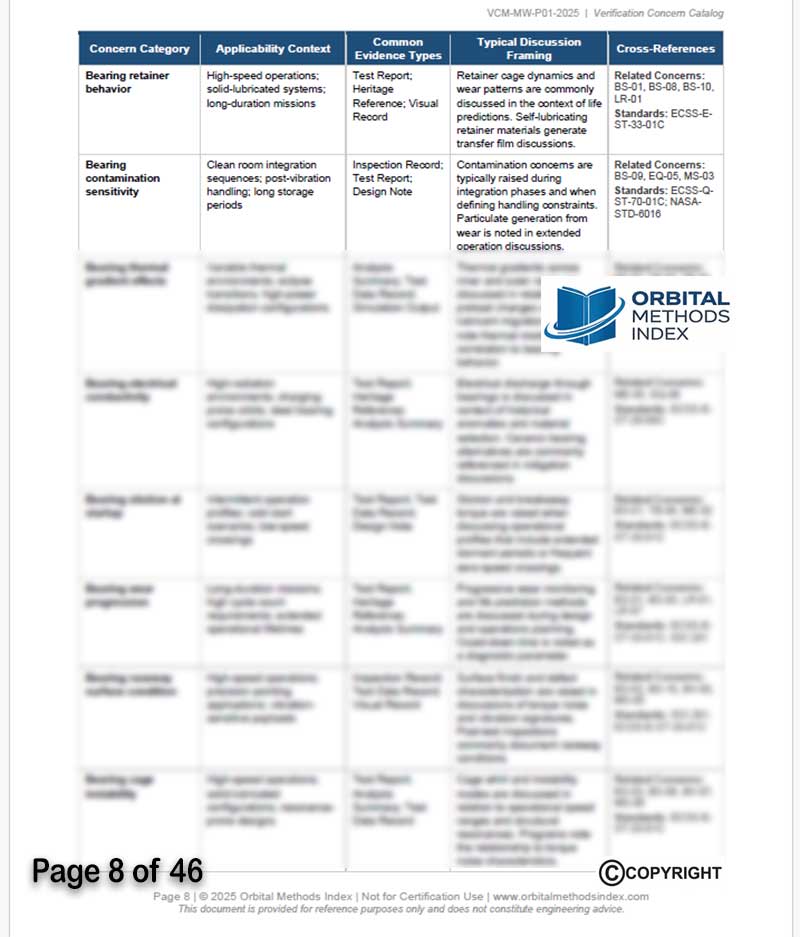
OMI Reaction & Momentum Wheel Core Verification Coverage Map™ (VCM-MW-P01)
49-page comprehensive reference documenting 63 verification concerns across eight functional domains: Bearing Systems, Motor and Electronics, Mechanical Structure, Balance and Vibration, Thermal Behavior, System Integration, Environmental Qualification, and Life and Reliability. Includes cross-cutting patterns, review question archetypes, and mission profile considerations.
OMI Research Bibliography for Reaction & Momentum Wheels (VCM-REF-MW-2025 v2.0)
Durable academic-style bibliography with 30 authoritative sources supporting VCM patterns. Uses persistent identifiers (standards, NTRS citations, DOI, ISBN) rather than URLs for long-term validity. Demonstrates research foundation and enables independent verification of verification pattern claims.
Interactive Working Tools
OMI Interactive Concern Catalog — Excel Working Reference (VCM-MW-S04)
Searchable, sortable Excel workbook containing all 63 concerns with filtering by domain, applicability, evidence type, and cross-references. Includes review preparation worksheet for tracking concern relevance to specific programs.
OMI Motion Wheel Verification Planning Worksheet (VCM-MW-W01)
Structured planning template for mapping VCM concerns to program verification activities. Four-section format: Program Verification Context, Domain Coverage Strategy, Verification Activity Mapping, and Gap & Risk Summary. Designed for capturing decisions without prescribing approaches.
Presentation and Communication Materials
OMI Motion Wheel Verification Reference Slides (VCM-MW-RS01)
Professional slide deck for introducing VCM framework to project teams, stakeholders, and review boards. Covers VCM purpose, concern catalog overview, domain structure, and usage contexts. Adapts to technical reviews, planning meetings, or stakeholder briefings.
Specialized Guides
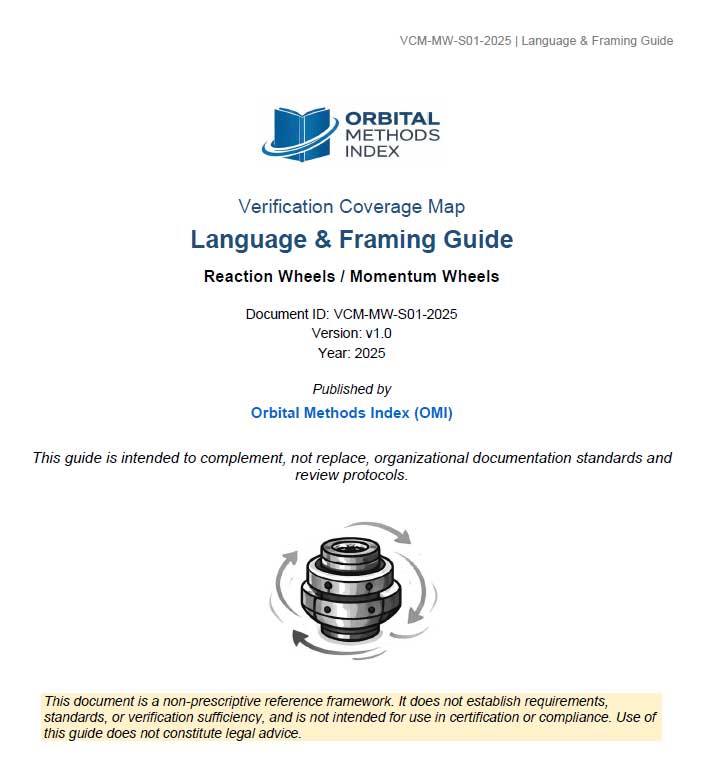
OMI Language & Framing Guide: Reaction & Momentum Wheels (VCM-MW-S01)
Documents language patterns observed during reaction wheel verification discussions. Covers how verification boundaries are typically framed, how evidence adequacy is discussed, and how acceptance criteria are negotiated. Helps teams understand discourse dynamics without prescribing what to say.
OMI Review Preparation Guide: Motion Wheels (VCM-MW-S02)
Patterns for preparing verification presentations and responding to review questions. Organized by review type (PDR, CDR, TRR, FRR, acceptance) with concern focus areas, typical question patterns, and evidence preparation observations.
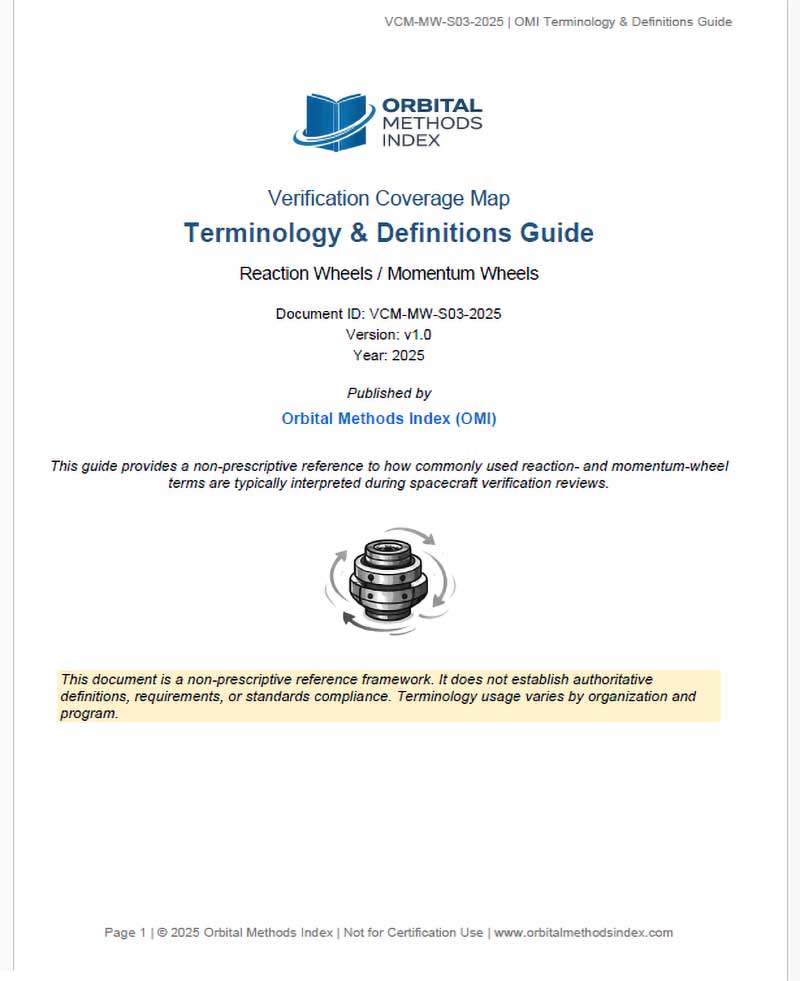
OMI Terminology & Definitions Guide: Reaction & Momentum Wheels (VCM-MW-S03)
40 specialized terms used in reaction wheel verification discussions, defined with usage context and common interpretation variations. Reduces ambiguity in technical discussions and review documentation.
Implementation Support
OMI Integration & Use Guide (VCM-MW-GUIDE-2025)
Comprehensive guidance for incorporating VCM framework into existing verification processes. Covers getting started, using tools effectively, adapting to program contexts, and integrating with standards frameworks (ECSS, NASA, MIL-STD). Includes workflow examples and common usage scenarios.
Who This Is For
Primary Audience:
- Verification engineers leading reaction wheel acceptance activities
- QA managers establishing verification approaches for spacecraft programs
- Systems engineers coordinating subsystem verification reviews
- Integration and test leads planning qualification and acceptance testing
- For on boarding junior engineers or new team members
Also Valuable For:
- Reaction wheel subsystem suppliers preparing for customer reviews
- Program managers requiring verification visibility without micromanaging technical details
- Independent V&V teams needing comprehensive concern coverage baselines
- Technical reviewers evaluating verification adequacy across multiple programs
How This Package Is Intended to Be Used
Phase 1: Orientation and Planning (Week 1)
Read the Core VCM (P01) to understand the verification concern landscape. Use the Integration Guide to determine which components are most relevant to your program. Complete the Verification Planning Worksheet (W0 1) to map concerns to your verification activities.
Phase 2: Team Integration (Weeks 2-3)
Share Reference Slides (RS01) with project team to establish common framework. Review Language & Framing Guide (S01) to align on verification terminology. Use Interactive Catalog (S04) to identify domain-specific concerns requiring attention.
Phase 3: Review Preparation (Ongoing)
Consult Review Preparation Guide (S02) when planning for specific review types. Reference Terminology Guide (S03) to resolve definitional ambiguities. Use Interactive Catalog filters to focus on concerns relevant to specific test activities.
Phase 4: Verification Execution (Throughout Program)
Keep Core VCM and Interactive Catalog accessible during verification activities. Use Planning Worksheet to track concern coverage as verification progresses. Reference Research Bibliography when claims need independent validation.
The materials are designed for repeated consultation rather than linear reading. Most users focus on 2-3 components initially, then reference others as specific needs arise.
What You Get (Practical Outcomes)
Verification Coverage Visibility
Clear view of which verification concerns exist, why they matter, and when they typically arise. Reduces risk of overlooking critical concerns during planning or review.
Review Confidence
Language patterns, question archetypes, and evidence framing guidance help teams anticipate and prepare for verification discussions. Particularly valuable for engineers new to reaction wheel reviews.
Planning Efficiency
Structured worksheets and interactive tools accelerate verification planning. Typical users report 40-60% reduction in time spent determining “what needs to be verified” compared to starting from blank page.
Team Alignment
Common vocabulary and shared concern framework reduce misunderstandings during verification discussions. Particularly valuable in multi-organization programs with diverse technical backgrounds.
Stakeholder Communication
Reference slides and terminology guides provide ready-made materials for explaining verification approaches to management, customers, or independent reviewers.
Research Foundation
Durable bibliography demonstrates verification patterns are grounded in authoritative sources (standards, NASA technical reports, peer-reviewed literature), supporting credibility in audit or dispute scenarios.
Why the Complete Package
Integrated Workflow
Components are designed to work together. Planning Worksheet references concerns from Core VCM. Interactive Catalog leads to Review Preparation Guide. Integration Guide shows how pieces connect. Purchasing separately requires users to mentally integrate the framework themselves.
Learning Curve Reduction
Integration Guide provides explicit guidance on using each component effectively. Without it, users spend time figuring out “how am I supposed to use this?” rather than extracting value immediately.
Consistent Terminology
All components use identical concern IDs, domain abbreviations, and cross-reference conventions. Eliminates confusion from mixing OMI materials with other sources or versions.
Complete Reference Set
Different users focus on different components based on role. Verification engineers live in the Interactive Catalog. Managers use Reference Slides. QA leads reference the Planning Worksheet. Complete package ensures entire team has access to relevant materials.
Relationship to Other OMI Tools
Builds On (Not Included):
VCM Foundation Series (FREE)
- OMI Momentum Wheels Evidence Taxonomy Quick Reference — (VCM-MW-F01)
- OMI Momentum Wheels Terminology Cheat Sheet — (VCM-MW-F02)
- OMI Top 15 Scrutinized Concerns — Reaction & Momentum Wheels (VCM-MW-F03)
Complete Package assumes familiarity with basic VCM concepts. Foundation Series provides introduction; Complete Package provides implementation depth.
Complements (Sold Separately):
OMI Universal Verification Witness Forms (UVWF)
Physical NCR forms for documenting verification activities. VCM guides what to verify; witness forms document what was verified.
Extends To (Future):
VCM Modules for Other Spacecraft Components
Star Trackers, Solar Arrays, Batteries, Propulsion Systems. Each follows same framework structure. Users familiar with Motion Wheel VCM can rapidly adopt other modules.
Executive and Procurement Justification
Risk Mitigation Value
Incomplete verification coverage represents program risk. Post-delivery failures cost 10-100x more than catching issues during qualification. OMI VCM provides systematic concern coverage baseline, reducing “we didn’t think to test that” scenarios.
Efficiency Gains
Engineering teams report 30-50 hour time savings during verification planning phases. At typical aerospace engineering rates ($150-250/hour), time savings alone justify package cost within single program use.
Knowledge Retention
Captures senior engineer verification knowledge in documented framework. Reduces dependency on individual expertise. Particularly valuable during staff turnover or when experienced personnel are unavailable.
Audit and Compliance Support
Durable bibliography with persistent identifiers demonstrates verification patterns are grounded in authoritative sources. Research foundation supports audit responses, regulatory compliance discussions, and independent review scenarios.
Multi-Program Applicability
Single purchase supports unlimited internal use across multiple programs. Unlike consulting engagements or program-specific analysis, OMI VCM framework applies to all reaction wheel verification activities.
Standards Integration
OMI VCM complements (not replaces) ECSS, NASA, and MIL-STD requirements. Integration Guide shows how to use VCM alongside standards frameworks without creating conflicting obligations.
Technical Specifications
File Formats:
- PDF (all documents): Optimized for reading, printing, annotation
- Excel (Interactive Catalog): Requires Microsoft Excel 2016 or later, or compatible spreadsheet application
Page Counts:
- Core VCM (P01): 40+ pages
- Research Bibliography: 9 pages
- Interactive Catalog (S04): Excel workbook, 3 worksheets
- Planning Worksheet (W01): 4 pages (editable template)
- Reference Slides (RS01): 5 slides (PowerPoint format)
- Language & Framing Guide (S01): 12 pages
- Review Preparation Guide (S02): 15 pages
- Terminology Guide (S03): 23 pages
- Integration & Use Guide: 13 pages
Total Documentation: 130+ pages + interactive tools (subject to change from revisions)
Licensing: Perpetual internal-use license for one organization or individual professional, unless otherwise specified. May not be redistributed externally or shared with other organizations without separate licensing agreement. See Orbital Methods Index (OMI) Usage & Licensing Terms for more details.
Support: Email support for technical questions about using materials. Does not include custom verification planning, program-specific consulting, or bespoke framework development.
Frequently Asked Questions
Q: Is this a standard or specification?
No. VCM documents observed verification patterns across programs. It does not establish requirements, specify acceptance criteria, or mandate approaches. Programs remain responsible for determining what applies to their activities.
Q: Does this replace ECSS-E-ST-33-01C or NASA standards?
No. VCM complements standards by providing concern-level granularity that standards don’t address. Integration Guide shows how to use VCM alongside ECSS, NASA, and MIL-STD requirements.
Q: How long does it take to implement?
Orientation phase (reading Core VCM, completing Planning Worksheet): 4-8 hours. Team integration (sharing slides, aligning terminology): 2-4 hours across multiple meetings. Full implementation varies by program complexity but most teams are operational within 2-3 weeks.
Q: What if our reaction wheels are commercial off-the-shelf?
VCM addresses verification from integrator perspective regardless of wheel heritage. COTS hardware still requires verification that it meets mission requirements, performs in mission environment, and integrates correctly with spacecraft systems. Domains like System Integration, Environmental Qualification, and Thermal Behavior remain relevant even for fully qualified COTS products.
Q: Is this specific to certain mission types?
VCM covers concerns observed across LEO, GEO, MEO, cislunar, and interplanetary missions. Mission Profile Considerations section (in Core VCM) describes how concern relevance varies by orbit, duration, and operational profile. Framework applies broadly; specific concern applicability depends on program context.
Q: Can we share this with our wheel supplier?
Materials can be shared with contractors working on your behalf under single-organization license. If supplier is independent organization, they would need separate license. Many programs find it valuable for supplier and integrator to use common framework.
Q: Do you provide training or consulting?
OMI focuses on publishing verification frameworks rather than consulting services. Integration Guide provides comprehensive implementation guidance designed for self-service use. For organizations requiring hands-on training or program-specific consulting, we maintain a referral list of independent verification consultants familiar with OMI frameworks.
What This Is Not
- Not prescriptive guidance. VCM describes how verification discussions commonly unfold. It does not tell you what to verify, what acceptance criteria to use, or how to design your verification program.
- Not a checklist. Not all 63 concerns apply to every program. Teams determine relevance based on mission profile, wheel design, heritage, and program constraints.
- Not a compliance tool. VCM does not establish requirements or create compliance obligations. It can be cited in verification documentation without creating liability.
- Not program-specific. Framework requires adaptation to program context. Planning Worksheet and Integration Guide help tailor approach to specific situations.
- Not a substitute for engineering judgment. VCM makes implicit verification knowledge visible. Engineers still determine what matters for their specific applications.
Purchase and Delivery
Price: $2,997 USD
Payment: Credit card, PayPal, Pay by Check, (Net 30 for established accounts)
Delivery: Immediate download access via secure link
License: Single-organization unlimited internal use
Volume Licensing: Organizations requiring multi-division licenses or consortium arrangements should contact sales@orbitalmethodsindex.com for volume pricing.
Verification Coverage Map™ and VCM™ are trademarks of Orbital Methods Index.